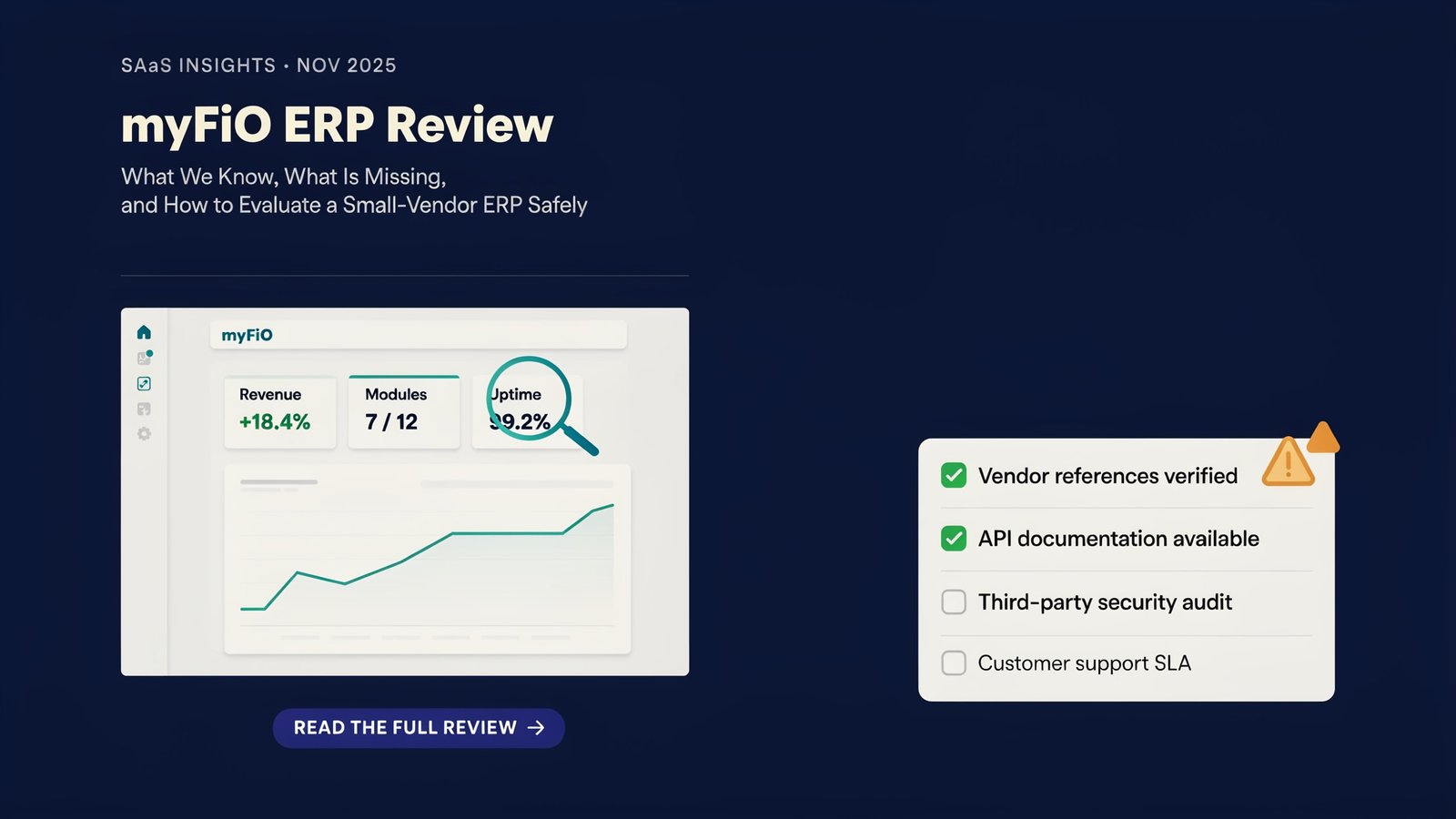
Some software is marketed very slickly, but lacks any independent evidence. That means that purchasing becomes a risk as the claims are not something you can easily check. MyFiO is a case in point, a small-business ERP and CRM with a definite pitch, and a thin paper trail in the public sphere. In this guide, we’ll outline what each of these sources actually states, highlight the limitations and datedness of these sources and provide a practical approach to testing any ERP that lacks documentation.
What It Is, and What It Isn’t
The platform is an ERP system designed for small businesses. A directory describes it as Group FiO’s professional edition of ERP built on opentaps open source technology. The company itself offers both open-source and paid ERP solutions for small and medium businesses.
Don’t confuse it with similar-sounding names: myFICO is a consumer credit-score app, and fio is a separate Linux tool for measuring disk performance. Neither is related.
Listings describe a wide feature set. One names CRM, purchasing, content, financial, inventory, manufacturing, loyalty, order and HR management, and another highlights warehouse management, supply chain management, reporting, purchase order management and order management as the top features. It is described as cloud-based. Language support listed includes English, Arabic, Traditional Chinese, French and Japanese.
The Technology Behind It
Understanding the base matters, because it shapes upgrades and support. Group FiO’s leadership says its solutions are based on the opentaps open source ERP and CRM suite. Opentaps is a web-based ERP and CRM for small to medium-sized businesses built on Apache Open for Business and written in Java, covering eCommerce, point of sale, inventory, warehouse, order and customer management, and general ledger.
That heritage has trade-offs. A developer who moved away from the open-source base to a rival wrote that deployment is not straightforward and requires a technical person and time. That comment comes from a competitor’s team and is dated, so treat it as a prompt for questions, not a verdict. If the product is hosted and supported by the vendor, much of that burden may shift to them. Ask who handles it.
What the Evidence Shows (and Its Age)
The bottom line is that there is virtually no independent evidence of day-to-day reliability, support quality or customer results. It is the biggest threat, and not as much as one or two features missing.
The price is also scattered. A directory states that it costs $7,500 per implementation on a one time basis and additional prices are quoted. The other listing indicates that the back office processing and ERP cost $7,500 once and CRM is $1,000 annually. They both seem to be fairly old, so assume that they are a jumping point to verify, rather than a quote. Another directory says that there is no trial access available, and lists ERPNext, Vasy ERP and Target One as competitors.
New Framework: The Thin-Evidence ERP Scorecard
If there is little evidence in the public eye, put the burden on the vendor. Score each item 0 (no answer), 1 (partial) or 2 (clear, documented):
- Current customers: Are there three current customers who are of your size that you can call?
- Release history – Does it have a dated history of releases in the past 12 months?
- Customization security: How will your custom changes be maintained with updates?
- Data Ownership: Are you able to export all data in a standard format whenever you want?
- Support terms: Do the terms include any guarantees of response time?
- How is the data stored and how is it backed up?
- Do they record access control and incident management procedures?
- Exit plan: What will it take to leave?
13-16: Proceed to a pilot. 8-12: Fill in the holes in writing first. If this comes at a price less than 8: The risk is probably still not worth the benefit; try something that has been proven.
Original Framework: The 30-Day Pilot Test
Do not sign a contract without a trial period, and discuss a paid or sandbox trial before signing a long-term contract. A reasonable structure:
- Week 1: Load a realistic sample of products (100), customers (50) and suppliers (20). One platform’s capabilities include exporting all the data for customers, suppliers, products, inventory and GL accounts without having to enter all the information by hand, so import your grottiest customer & supplier data into that platform to see how it handles.
- Week 2: Perform a complete order to cash process: quote, order, shipment, invoice, payment.
- Week 3: Conduct a purchase to pay cycle (receiving and reconciling).
- Week 4: Get your normal reports and check the totals with your current books.
Pass criteria (before starting): No balance differences between imports and exports, less than 2% manual fix, support reply on time. Those thresholds are recommendations; customize them to your level of risk.
If you do this pilot, share the actual findings: Import Error Rate, Hours Spent, Support Response Times, Any Recon Reconcile Gaps. Only include numbers you measured.]
Whose responsibility is it, and who should not take it?
MyFiO might be good for a small trading, distribution or retail company that wants to have all inventory, purchasing, accounting and CRM in one place and doesn’t mind an open source-based product and small vendor. It is a bad fit if you require verified compliance certifications, a big partner ecosystem, local-language tax rules you can’t verify, or copious independent reviews to which you can turn. Before making your choice, see at least one alternative documented by others that is better known, like one of the competitors mentioned above.
Final Thoughts
As a viable small-business ERP, with a sound technical base, myFiO has a weak and dated body of public evidence—this is what counts for the buyer. Do not assume that a feature list is an evidence of proof. Use the 8 point scorecard, make sure to call for references and test it using your own trashy data for a 30-day pilot period before entering into a long-term agreement. If these steps aren’t going to occur, it tells you what you need to know.

One Response