Quick Answer
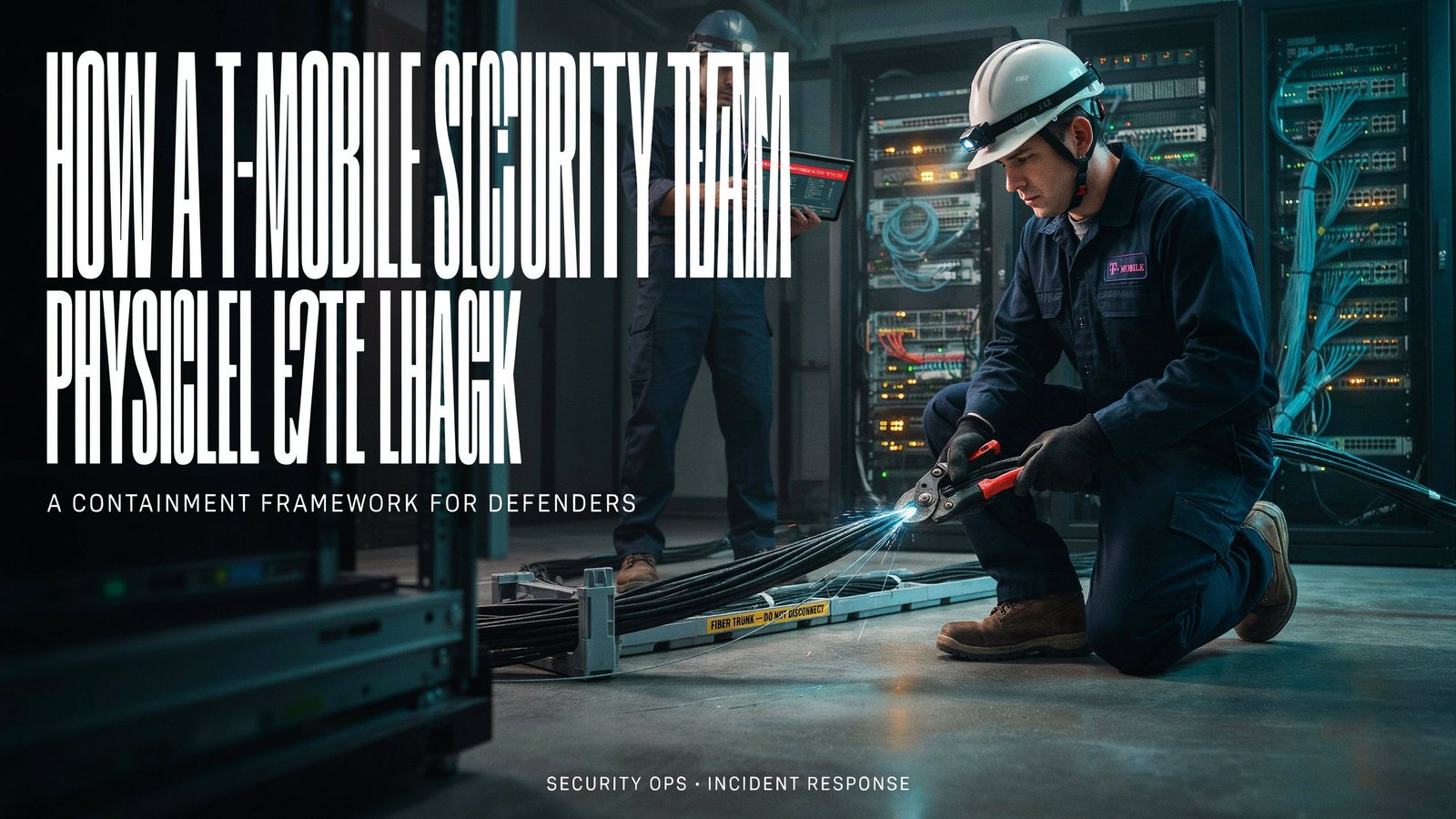
In November 2024, four people from T-Mobile’s security team went to a data center near the company’s Bellevue, Washington headquarters, located a compromised system and cut its network cable with scissors. Security chief Jeff Simon told Bloomberg that he and three others found the compromised box and snipped the cable connecting it to the outside world. The adversary was Salt Typhoon, a China-linked espionage group.
The takeaway is not “keep scissors in the server room.” It is that when you can’t trust your remote tools, physical isolation is the most certain way to end an intruder’s access. This guide explains what happened, why the physical option won, and how to decide when it’s right for your organization.
Why the Incident Matters
The cable cut was the last step of a long campaign. Salt Typhoon compromised hundreds of companies, including AT&T, Verizon, Viasat, Charter and Windstream, to gather phone records and intelligence on senior U.S. government officials. Reporting also says the group got into lawful-intercept platforms, which are surveillance systems built for law enforcement.
T-Mobile largely avoided a widescale breach. According to Simon, the team spent months hunting for intruders using intelligence from government agencies and other telecoms, after strengthening its defenses following a separate 2023 breach. The scissors worked because of the preparation behind them.
Remote vs. Physical Containment: A Comparison
Why drive to a data center when a router can be disabled from a laptop? Simon said the team could have disabled the router remotely, but judged a physical cut faster and more certain. There was also a stealth argument: software-based eviction might have tipped off the attackers and pushed them to hide better.
The table below is our own editorial analysis of the trade-offs, not T-Mobile data.
| Factor | Remote (software) isolation | Physical isolation |
| Speed | Instant if you have access | Slower: travel and site access |
| Certainty | Depends on the device and its management plane being trustworthy | Very high once the right cable is identified |
| Attacker visibility | May trigger changes the attacker can observe | Operates outside the compromised device’s control |
| Reversibility | Easy to undo | Requires on-site restoration |
| Evidence handling | Risk of altering volatile data | Device can stay powered on for imaging |
| Scalability | High | Low: one link at a time |
| Best fit | Many hosts, attacker unaware | Management plane may be compromised, target is known |
The principle underneath: if an attacker might control or monitor your management layer, a command sent through that layer is not a guarantee. A physical action sits outside it.
The Cut-Line Framework: 5 Questions Before You Pull the Plug
We built this framework from the T-Mobile case as a decision aid. It is not T-Mobile’s internal process.
- Is the target confirmed? Physical isolation is only as good as your identification of the right device or link. One analysis flagged the real risk: what happens when the next cable is harder to find.
- Can you trust the control plane? If the attacker could see or manipulate your remote tools, move toward physical action.
- What is the blast radius? Cutting one link to one box is a different decision from cutting a backbone. Know what breaks.
- How will evidence be preserved? Severing a network cable leaves the device powered, so memory can still be captured. Assign who images it before anyone else touches it.
- Is the decision pre-authorized? Name who approves a physical cut, who has data center access at 2 a.m., and who drives.
Scoring: if you can’t answer “yes” to at least four of five, your physical-containment option isn’t ready yet.
Lessons for the Wider Industry
Hunt before you’re certain. The team spent months searching without success before finding the intrusion. Threat hunting is a standing program, not a sprint.
Treat partners as part of your perimeter. eSecurity Planet reports that suspicious activity was traced to infrastructure connected to another telecom provider, and recommends reviewing trusted partners and interconnected networks for unnecessary access.
Share intelligence. T-Mobile’s hunt drew on information from agencies and peers. No one company saw the full campaign.
Expect policy fallout. The U.S. Treasury sanctioned Sichuan Juxinhe Network Technology Co. as an identified corporate enabler of Salt Typhoon.
Linkable Asset: Physical Containment Readiness Checklist
- Network diagrams show every external connection to critical systems
- Each data center has a named contact with 24/7 access
- An out-of-band communication channel exists if email and chat are compromised
- A decision-maker is pre-authorized to approve physical isolation
- Forensic imaging steps are documented for devices left powered on
- Cable and port labeling is audited at least annually
- A tabletop exercise has covered a “pull the cable” scenario
- Third-party and interconnect links are inventoried and reviewed
Open Questions for Expert Contributors
- Incident responders: How do you choose between remote and physical isolation when a colocation or cloud provider controls the hardware?
- Telecom engineers: How should lawful-intercept systems be segmented so they can’t become an entry point?
- Forensics specialists: What is best practice for capturing volatile evidence once a link is severed?
- Policy analysts: Do sanctions and public attribution change attacker behavior?
Conclusion: The Practical Takeaway
A frayed piece of the yellow cable is now framed at T-Mobile’s headquarters. It is a trophy, but the real lesson is the months of hunting, shared intelligence and decisive leadership behind it.
When a T-Mobile security team physically cut a cable to expel hackers, it proved that the best containment move can be the simplest, provided you’ve done the groundwork. Know your network, decide in advance who can act, and rehearse the scenario before you need it.
Next step: This week, run the five Cut-Line questions against your most critical system. The gaps you find are your priority list.