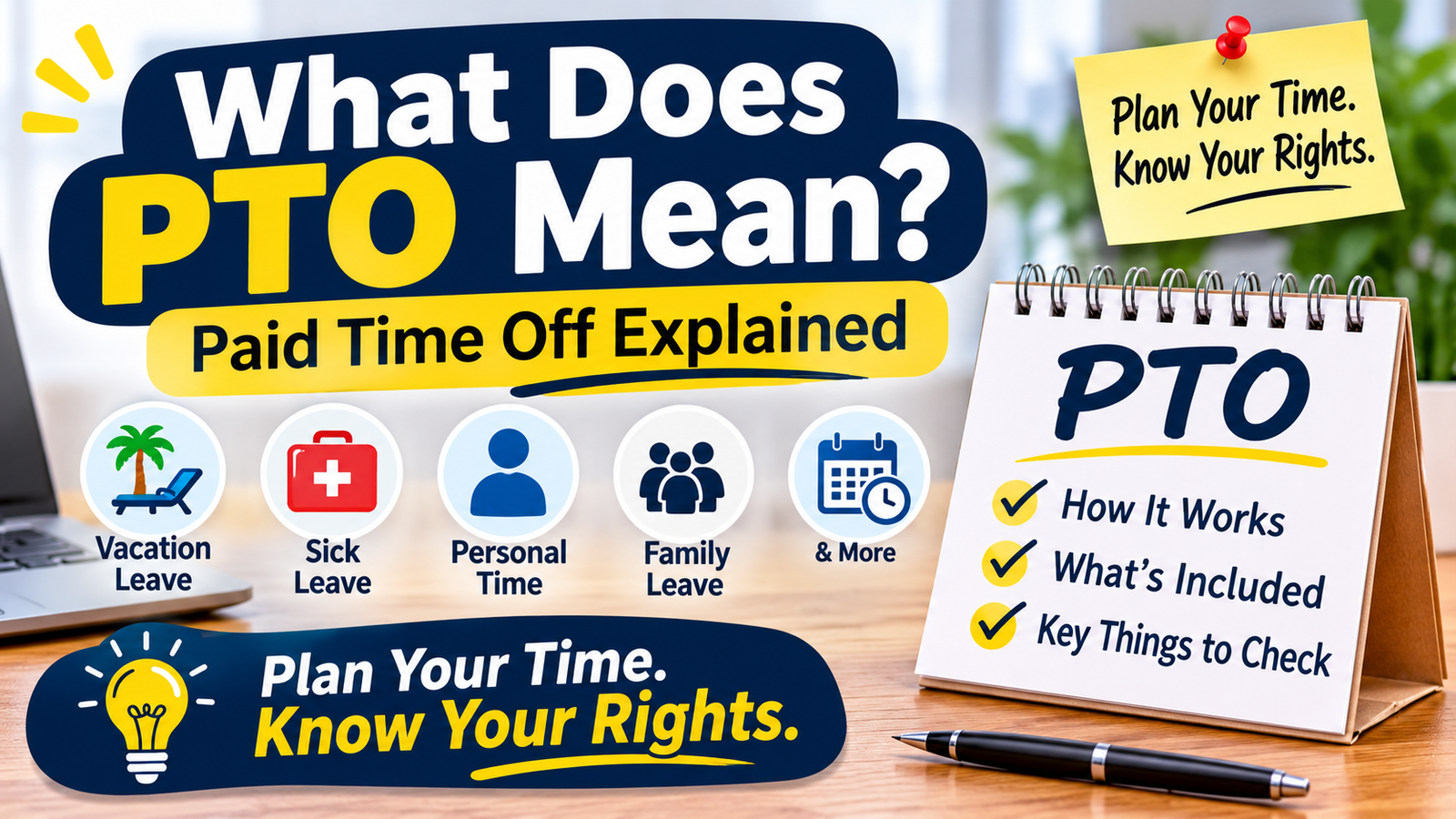
What Does PTO Mean?
Paid time off (PTO) is a staff benefit which enables people to take time off work, and still continue to be paid.
It is good to have an awareness of how PTO is defined and utilised, so that you may analyse a position, organise your time and/or manage your workload. Typically, organisations allow people to utilise PTO for holiday, personal and sickness related reasons.
Different organisations can define PTO in different ways, based on their own policy and working practices.
[Paylocity] highlights that ‘businesses can offer employees different PTO provisions’.
How Does PTO Work?
Generally, businesses enable staff to access PTO through either an accrual or lump sum format.
Accrued PTO
Staff can build up PTO over time. This can be on an hourly, monthly or pay cycle basis.
Lump Sum PTO
Businesses may issue a lump sum of PTO at the start of a particular timescale e.g. a year.
Example
An employee has been granted a total of 15 days PTO per year. They also work for 8 hours daily.
| Calculation | Amount |
| Annual PTO entitlement | 15 days |
| Annual hours | 120 hours |
| Monthly PTO accrual | 10 hours |
| Quarterly PTO entitlement | 30 hours |
Such basic calculations can therefore be utilised to ascertain how much PTO someone is accruing.
Employers need to ensure that staff understand who is entitled to PTO and how this is accrued. They should also define what is required to request time off and set out guidelines for unutilised PTO.
What Can Be Included in PTO?
Depending on a business’ working policy, businesses may include any of the following in PTO:
- Holiday – For leisure and travelling.
- Sickness – For health related reasons.
- Personal – To manage personal matters and/or unforeseen issues.
- Family Specific – Some businesses also add family related time off.
- Floating – Extra PTO which can be used for personal or cultural reasons.
In some cases, PTO will be distinct from other time off such as maternity, paternity, compassionate and legally recognised family or health Related Leave.
Never automatically assume that all time off relates to one PTO fund.
PTO, Holiday and Sick Leave
Whilst these often tend to be used synonymously, they can in fact differ.
| Leave Type | Main Use |
| PTO | General time off for authorised reasons and in receipt of pay. |
| Holiday | Leisure and travel related time off. |
| Sickness | Health related time off. |
| Personal | Personal matters. |
Three-Bucket or Single-Bank PTO
It can also be beneficial to recognise whether your place of work operates under a three bucket or single bank PTO provision.
Three Buckets – Holiday, sickness and personal time off are all in distinct funds.
Single Bank – Staff are given one overall fund of PTO for various permitted reasons.
Although a single bank allows greater freedom, a three bucket format can allow for specialised funds to meet particular requirements.
There is no definitive ‘better’ option between these two. The most suitable provision will typically depend upon an individual’s situation together with business policy and relevant legislation.
What Should Staff Analyse in Relation to PTO?
There are key points to analyse within a PTO provision. These include:
- The annual entitlement – How many days and/or hours of PTO is staff granted?
- Accrual or Lump Sum – Whether PTO is accrued or given in lump sum format.
- Unused PTO Rollover – Whether unutilised PTO can be rolled over.
- Notice Period – What is the required notice period for requesting time off?
- Leaving a Position – How is unearned PTO dealt with upon leaving a position?
Such factors can often differ greatly depending on where someone lives.
Whilst federal legislation in the USA generally does not oblige private sector businesses to offer staff paid holiday, there may be further obligations arising from state and local laws.
For more details on federal labour laws and working standards, please refer to the U.S. Department of Labor website.
Conclusion
Being aware of PTO is valuable so that staff can analyse working benefits, organise their time and prevent confusion regarding time off with their employer.
Always check your employee handbook and discuss with HR to ensure you understand the correct PTO guidelines. Having such knowledge can greatly assist in the management of your time off.




One Response