In short: Availity is a healthcare information network that connects healthcare providers, health plans and technology vendors. Most providers fulfill it with Availity Essentials, an absolutely free multi-payer portal for eligibility, claims standing and prior authorizations. The question of whether it is free or not is dependent on whether it is sponsored by your payers.
What Availity Is (and the Naming Confusion)
“Availity” is used for three purposes, hence the different results found in different pages.
- Availity, LLC is the company. The secure, free portal you use to electronically work with multiple payers is called Availity Essentials.
- The portal is in front of the network. One review calls it handling 13 billion clinical, administrative and financial transactions each year. There are discrepancies in third-party figures of provider numbers which range from approximately 2 million to 3.4 million, so don’t put too much of a stake in any one.
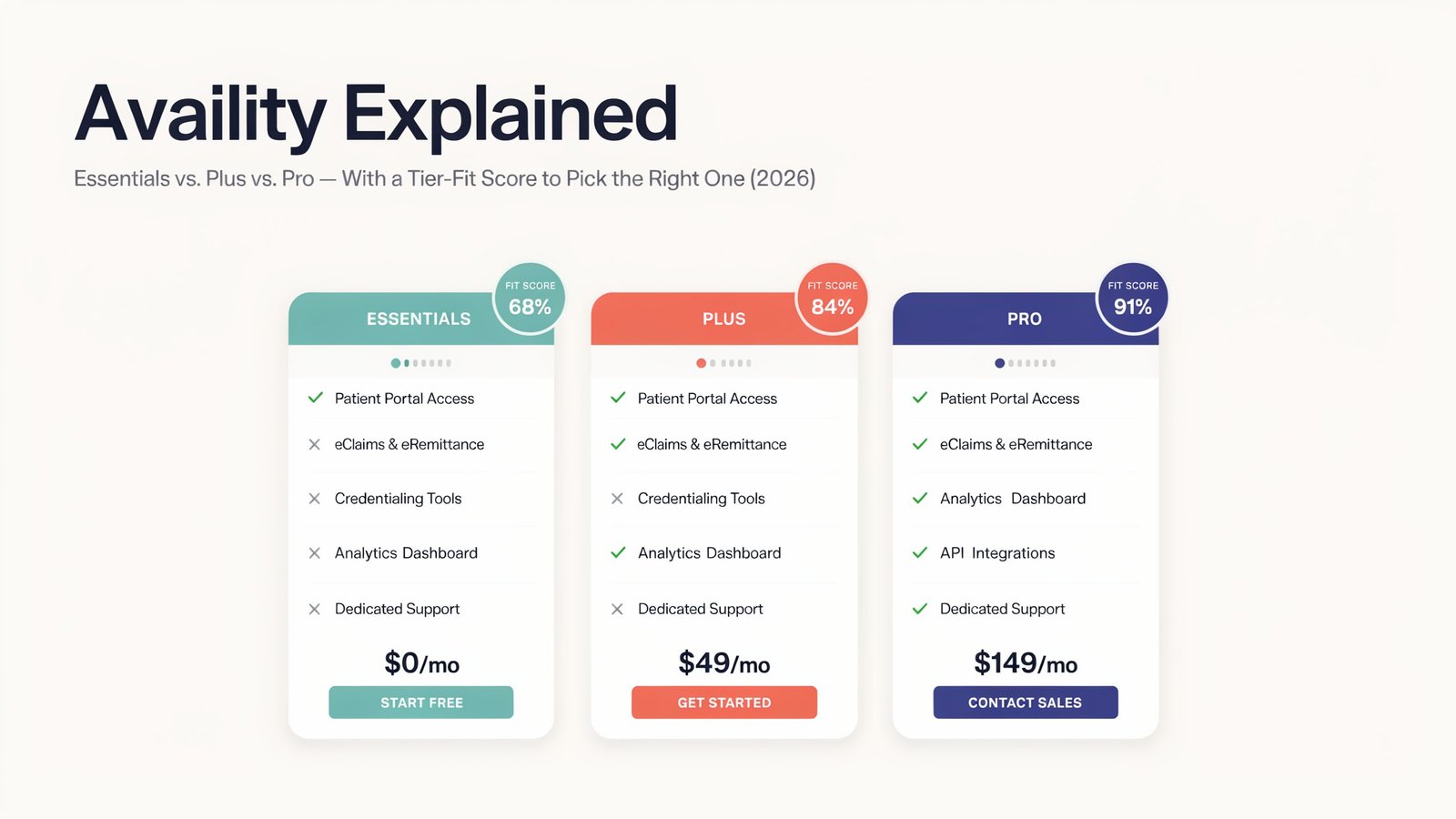
- The tiers include Essentials, Essentials Plus and Essentials Pro, which are detailed below.
The advantage to payers is that they don’t have to have their own relationship with each provider. Providers can rely on it to not have to log into a dozen insurer websites. Carelon Behavioral Health, for instance, refers to it as a secure, one-stop, self-service, multi-payer portal, and its preferred means of handling claims, eligibility checks, and tracking status.
What Providers Actually Do in Availity Essentials
The core workflows are consistent across payer documentation:
- Eligibility and benefits: the most common use.
- Claims: direct data entry, status checks, and appeals.
- Prior authorizations: one Blue plan’s FAQ describes the portal as covering member eligibility and benefits, prior authorizations and claims, and status checks.
- Payer-specific tools: many plans run their own “payer space” inside the portal. MVP, for instance, offers payer-specific resources, tools, and applications there.
Adoption is still spreading. AvMed announced that access to the Availity provider portal begins January 1, 2026. It also supports multiple Tax Identification Numbers and locations under a single account, which matters for group practices.
The Real Question: Who Pays? (Tier Comparison)
“Is Availity free?” gets a different answer from every source. The accurate answer is free if the payer sponsors it. Transactions with any sponsoring health plan are free through Availity Essentials, but two premium options charge a fee.
Pricing caveat: Some review sites cite different Plus prices (one reports around $35/month and says rates haven’t been refreshed). Confirm current pricing directly with Availity before budgeting. This table uses the figure vendor-comparison sources attribute to official materials.
Pricing transparency is Availity’s weakest competitive point: Pro, overages, and implementation fees are not fully disclosed.
Original Framework: The TechVistora Tier-Fit Score
Most Availity guides talk about the tiers but don’t explain which tier to purchase. We created a fast scoring program for that. It is a heuristic of the editor, and not a verified benchmark. Mark each question 0, 1, 2, 3 and 4.
1. Sponsor coverage. Which of your payer mix are Availity sponsors? (3 = under 50%, 2 = 50-75%, 1 = 76-95%, 0 = nearly all)
2. Non-sponsored volume. How many of the monthly checks do non-sponsored payers receive? (0 = under 50, 1 = 50-250, 2 = 251-500, 3 = over 500)
3. Automation is needed. Are you looking for batch transactions or EHR integrated claims? (0 = no, 1 = occasionally, 2 = regularly, 3 = core workflow)
4. Concentration risk. If your revenue cycle is halted, does one network outage? (0 = have backups, 3 = no backups)
Interpreting your total (0-12):
- 0-4: Conduct an annual review of Essentials (free).
- If you are looking for a more advanced 5-8 Year Old program, consider 5-8: Essentials Plus. Double-check that your actual volume is within the 250 transaction limit.
- 9-12: Ask a Pro or clearinghouse for a quote and get at least one quote from an alternative.
The one most guides will avoid is Question 4. Many providers were unable to file claims to any payers on that network for weeks during the Change Healthcare cyberattack this year. A second path of connectivity is not a luxury, it is an operational measure. intuitionlabs
Run the Tier-Fit Score on 5-10 real practice profiles that you have advised or interviewed, and publish the distribution. Avoid publishing without actual inputs.
Where Availity Falls Short
Real limitations worth flagging before you commit:
- Coverage gaps. If a health plan isn’t connected to Availity’s network, you cannot use the platform for that insurer. Availity is available across the US and its territories, but not all Blue plans contract with Availity.
- Data accuracy. Gartner Peer Insights reviewers praise the platform for managing provider data, but one complains that the data in Availity does not always correlate to in-house systems. Reconcile Availity data against your practice management system rather than trusting it as a source of truth.
- Tool-level constraints. One payer’s FAQ notes that the prior authorization tool currently accepts only three diagnosis codes. Constraints like this are set per payer and change, so check your payers’ current documentation.
- Uneven depth. Core transactions work well for sponsored payers, but depth of benefit detail and estimators varies by carrier.
Availity Readiness Checklist (Linkable Asset)
Use this before registering or upgrading:
- List your top 10 payers by claim volume.
- Check each payer’s provider site to see whether it is an Availity sponsor.
- Count last quarter’s eligibility checks to non-sponsored payers.
- Assign one organization administrator before registering, since the administrator receives an email with a temporary password and next steps.
- Complete the in-portal training. MVP points users to Help & Training, then Get Trained, for live and recorded webinars.
- Identify a backup clearinghouse or payer-direct route.
- Set a quarterly review: tier, volume, and data-mismatch log.
The Takeaway
Start with free Essentials, find your sponsor gap, and let that number drive your tier decision. Run the Tier-Fit Score, keep a fallback path, and verify pricing with Availity directly. Anyone quoting a flat “Availity cost” without mentioning sponsorship is leaving out the variable that matters most.


One Response