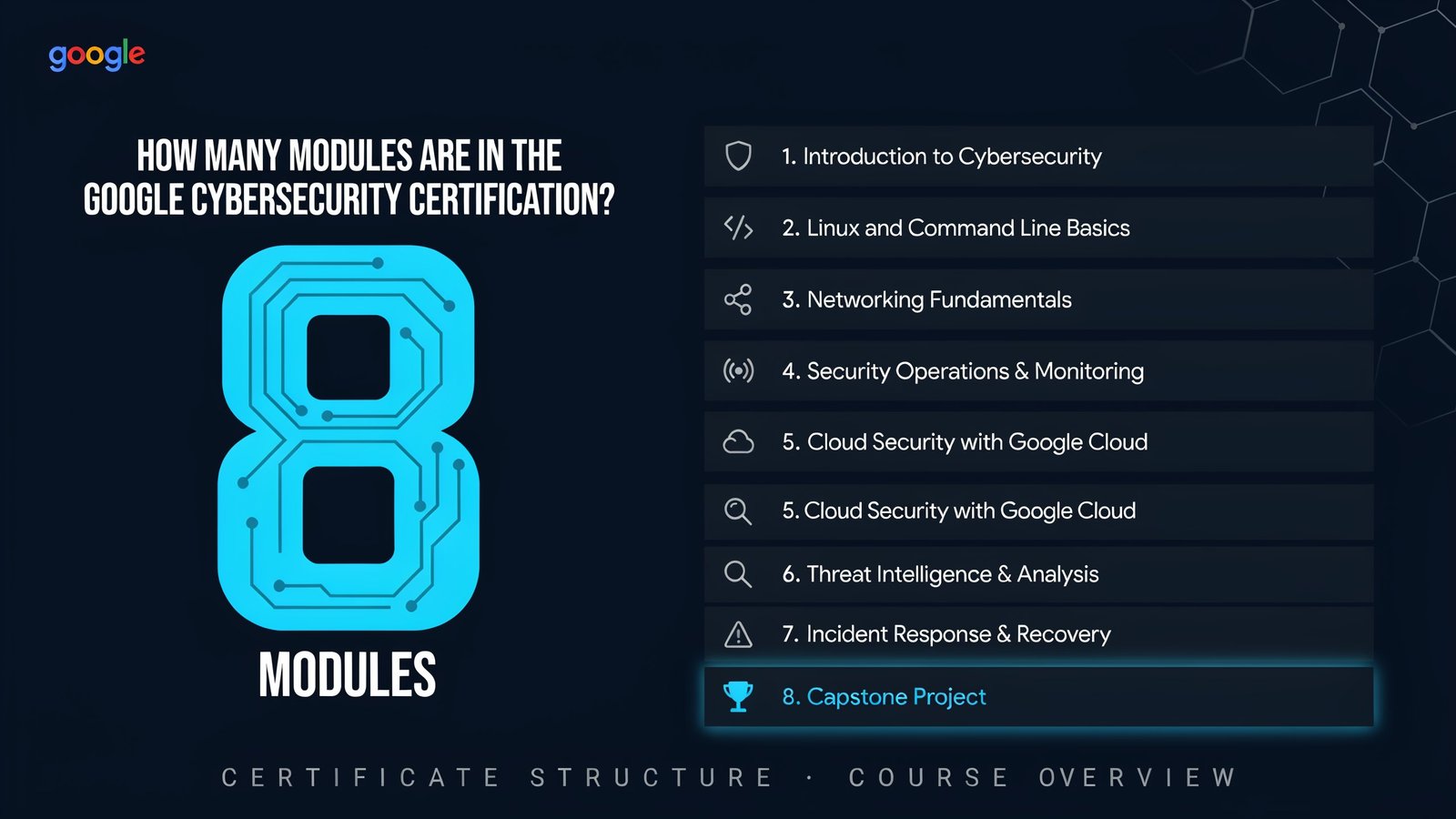
After you think about the Google Cybersecurity Certificate as a method to get into the security sector, it is one of the initial useful questions that is to be discussed: just how’s the programme structured? Knowing how many modules in Google cybersecurity certification are involved will allow you to plan what you will have to study, which is crucial to know before taking your time and effort to finish it.
The overall structure of the Program
There are nine courses in all included in the certificate as of 2026 (formerly eight). Google has continually been evolving to keep up with the changing landscape of hiring and the technology in the workplace, so they have added a new course on how to prepare for a job search with the assistance of AI.
All nine of these courses have been divided into separate units called modules, also known as weeks, which provide more manageable, digestible chunks of learning. The structure is a modular-based rather than continuous where the learner can advance through particular topics and then to the next.
Each course has different modules. Modules are broken up for each course
The number of modules per course may vary slightly from course to course, but would typically be three to five modules per course. For instance, in the series of courses some might have four modules, each covering a particular topic that contributes to the learning objective for the course.
So, if you take the full 9 course hours, there are literally dozens of single course modules over the course of the program, each with video courses, reading, quizzes and sometimes hands-on drill exercises for reinforcing the content covered.
Each Course covers:
The context of the module breakdown can be understood by knowing the overall course structure. The course starts with the basics security concepts and threat types move onto risk management frameworks, network security fundamentals, as well as hands-on practicals such as Linux and SQL.
Following courses delve into asset and vulnerability management, detection and response strategies, and automating with Python. Finally, there’s a series of job preparation tips, such as creating a resume, developing a portfolio and preparing for interviews, with the new module dedicated to using AI in the job search process.
The advantages of the Modular Format.
The benefit of dividing the program into these structured modules as opposed to a single course is real educative benefits. Each module is normally on a clearly-defined topic, allowing learners to see how far they have got and to refer back later to an individual module if they want to refresh their understanding of the individual concepts.
This also gives the entire program a more manageable feel. Instead of nine huge, unsegmented courses, students are guided through small, targeted units of instruction that fosters increased retention and daily progress—and are especially effective for students taking multiple courses on-site while juggling other responsibilities.
Estimated Time Commitment
As being spread over nine courses, most students manage to finish the entire program within about 6 months of studying about 7 hours a week. Of course, this is subject to change according to the persons pace, prior exposure to technical ideas as well as time dedicated each week.
The program is self-paced, so that means that learners are not tied to a strict plan and they may have the opportunity to move at their own pace, either being faster or slower, depending on personal habits, and the speed at which they have some concepts “clicked.
Practical activities throughout units including exercises
In addition to video lectures and reading material, many modules feature labs with real industry tools such as Splunk and Wireshark, as well as real-world lab sessions and practical lab exercises on programming languages like Python, Linux and SQL. Each module has a practical component so that practical skills are developed as well as theoretical aspects which will be useful in real life situations after each module is completed.
Technical aspects are taught in a gradual manner, not all in one or two courses, and by alternating hands-on activities throughout all of the program’s courses.
Does the number of modules undertaken have an impact on the value of the certification?
It is worth noting here that in and of itself, the number of modules may not be the most important aspect to employers or industry recognition. What’s more important is that the program gets learners ready for the CompTIA Security+ exam, an industry credential, in addition to acquiring real world skills that can be directly applied to an entry-level job, such as a security analyst or SOC analyst position.
It is important to know how many modules in Google cybersecurity certification structure works when planning a strategy for studying and it is not a factor which has a bearing on the professional recognition of the certificate.
Final Word
With this knowledge you can have realistic expectations before enrolling in the Google cybersecurity program, knowing exactly how many modules in Google cybersecurity certification structure exist. The certificate features nine courses with multiple sets of focused modules, providing an organized approach to understanding the basics of cybersecurity with lightweight theoretical material, followed by practical, real-world application that will equip students with the skills and knowledge required for entry-level opportunities.



