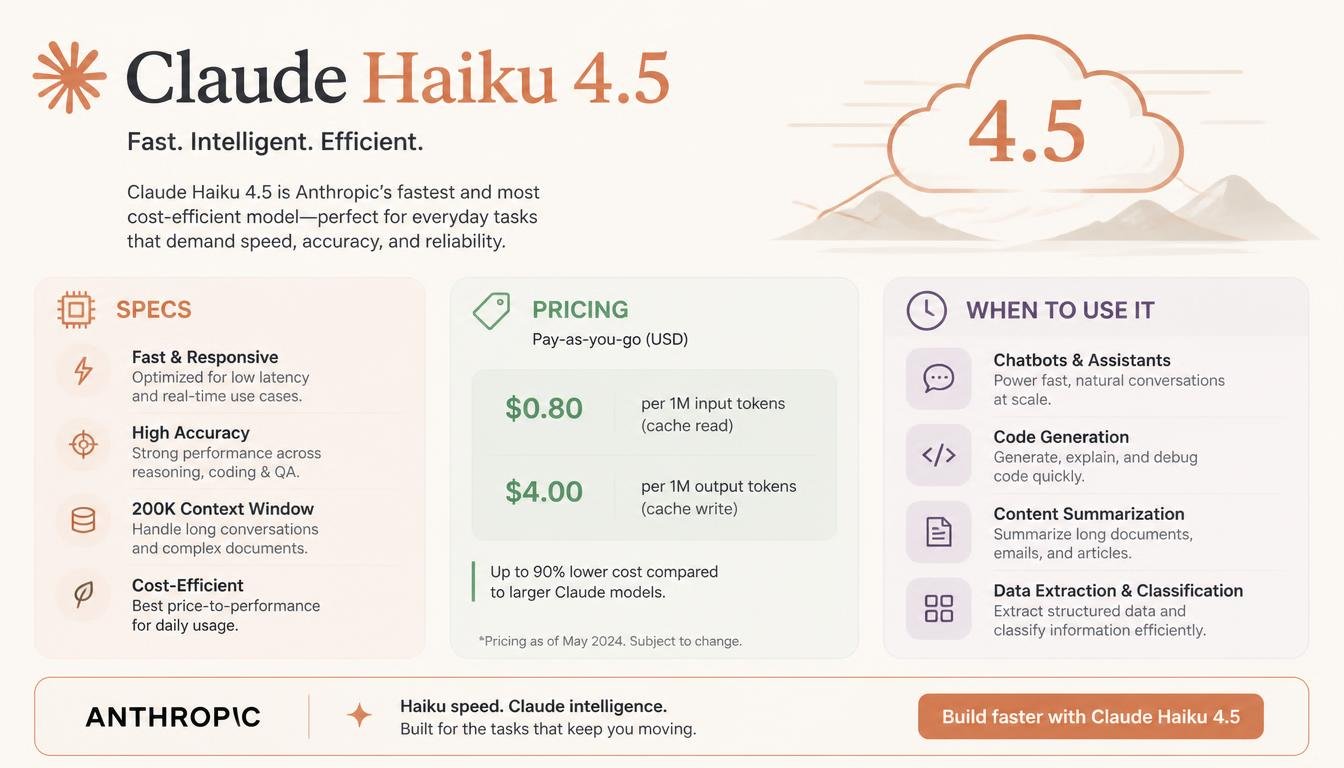
Claude Haiku 4.5 is Anthropic’s most recent model, which is the fastest and cheapest of all the Claude products. According to Per Anthropic’s documentation of their models, it has a context window of 200K tokens, a maximum output of 64K tokens, costs $1 per million input tokens and $5 per million output tokens, and was trained to know until February of 2025. Select it for high volume / latency sensitive work; upgrade to a bigger model when tests indicate it is not performing adequately.
Claude Haiku 4.5 Specs at a Glance
These specifications are provided in the documentation page of the model:
| Spec | Claude Haiku 4.5 |
| Window of context | 200K tokens |
| Maximum output | 64k Tokens |
| Price per million tokens | $1 input, $5 output |
| Latency | Fastest in the current lineup |
| Thinking | Extended thinking |
| Knowledge cutoff | February 2025 |
| API model ID | claude-haiku-4-5-20251001 (alias claude-haiku-4-5) |
The alias claude-haiku-4-5 is pinned as the snapshot claude-haiku-4-5-20251001. The information adds that Claude Haiku 4.5 can be used via Amazon Bedrock’s InvokeModel area and Bedrock style model IDs and that here’s a way to question limits and capabilities programmatically with the Models API. There’s also a 50 percent discount on input and output, but read the pricing documents to find out which feature you’re sampling before making any plans based on it.
How It Compares to Larger Models
The same documents show a “Current face-off lineup”. Eliminating context, output length and recency are a sacrifice for speed and price in Haiku 4.5.
| Model | Context | Max output | Price per 1M tokens | Latency | Thinking |
| Claude Fable 5 | 1M | 128K | $10 / $50 | Slower | Adaptive (always on) |
| Claude Opus 5 | 1M | 128K | $5 / $25 | Moderate | Adaptive |
| Claude Sonnet 5 | 1M | 128K | $2 / $10 | Fast | Adaptive |
| Claude Haiku 4.5 | 200K | 64K | $1 / $5 | Fastest | Extended |
Haiku 4.5 implements a manual extended thinking (where you enable it and set a token budget), instead of the adaptive thinking that the larger models use. It also has the oldest knowledge cutoff (February 2025), which means that if you want to search for recent facts you’ll need to include them or provide one of these tools.
What the Cost Is in Practice
Claude Haiku 4.5 What the cost in practice is (Original calculation)
It is difficult to visualize prices per token so here is an example. Suppose that a typical request contains 2,000 input tokens and 500 output tokens. This is not a benchmark of The Anthropic, but my own basic calculations based on the prices listed.
| Model | Cost per request | Cost per 1,000 requests |
| Claude Haiku 4.5 | $0.0045 | $4.50 |
| Claude Sonnet 5 | $0.009 | $9.00 |
| Claude Opus 5 | $0.0225 | $22.50 |
| Claude Fable 5 | $0.045 | $45.00 |
Actual costs will rely on your prompts, caching, batching and any thinking tokens, as thinking output will count as output. Do not use the table to predict an invoice, but to compare models.
The Right-Sizing Ladder
This Original Framework is also available as “The Right-Sizing Ladder”.
In Anthropic’s documentations are some directions about when it matters for efficiency on Haiku and when it is time to get a bigger model. This editorial ladder brings it to fruition.
- Use Haiku 4.5 for the task and use a small test set of real examples written.
- Measure. Monitor your own accuracy, latency and cost on all your cases.
- Include thinking when the task requires reasoning with a small, token budget.
- Increase in effort on failure. Test Sonnet 5 on specific cases first if these ones don’t work.
- Route. Make simple requests to Haiku and difficult requests to the larger model.
Where Haiku 4.5 Tends to Fit
How Haiku 4.5 Tends to Fit (Original Comparison)
This is not a benchmark, but an Editorial Fit Table.
| Task | Good fit? | Why |
| Comprehending information, tagging, and routing it | Strong | Short responses, large quantity of output |
| Data extraction from documents | Strong | Structured regular task(s) |
| Customer facing chat — there’s no question here whether speed is important or not. | ||
| Individual sub-agent tasks within larger systems | Strong | Low cost per call |
| Summarizing medium-length documents (up to 200k) | Good | Fits in 200K context |
| Enduring a very large codebases or books was weak | 200K | max context size |
| Conducting the test early helps identify which model is required.An early test can see whether a bigger model is needed, or not. |
A Minimal API Example
This is an untested example run with your own key prior to its use. Saves the dated snapshot and allows for out-of-the-box thinking via the use of a token budget:
python
import anthropic
client = anthropic.Anthropic()
response = client.messages.create(
model=”claude-haiku-4-5-20251001″,
max_tokens=2000,
thinking={“type”: “enabled”, “budget_tokens”: 1024},
messages=[{“role”: “user”, “content”: “Classify this support ticket: …”}],
)
print(response.content)
Pinning snapshot – if a snapshot is pinned, behavior remains fixed. This is because the alias is more readable, and it resolves to whatever snapshot Anthropic points at.
Evaluation Checklist
This is the Claude Haiku 4.5 Evaluation Checklist (Linkable Asset).
- Created 20 to 50 real test cases to perform my task
- Ran them on Haiku 4.5 first, before attempting the bigger models
- Measuring accuracy, latency and cost per request
- Tested context limit (200K) with my inputs.
- Tried extended thinking with a small budget
- Recall on knowledge cutoff in February 2025.
- Pinned the model snapshot for production
- Read the life cycle page for the model, reviewed the retirement page for the model.
- Execute routing for hard cases on to larger model
- Repeat tests with updated prompts/modes!
Guest Post Angles
Topics are appropriate for AI development and product publications:
- Right-sizing LLM cost: When the least expensive model is sufficient.
- Routing from small to large Models and vice versa – literally.
- Self-Gathering and Self-evaluation of LLMs with Small Test-sets.
Test Before You Upgrade
Write a small test set and run it on claude haiku 4.5 first one real task. If it does, then you have saved money and increased speed. If it doesn’t, you now know which cases require a larger model and you can only route those. Check actual prices, limits and life cycle status in Anthropic’s documentation as they could change.



