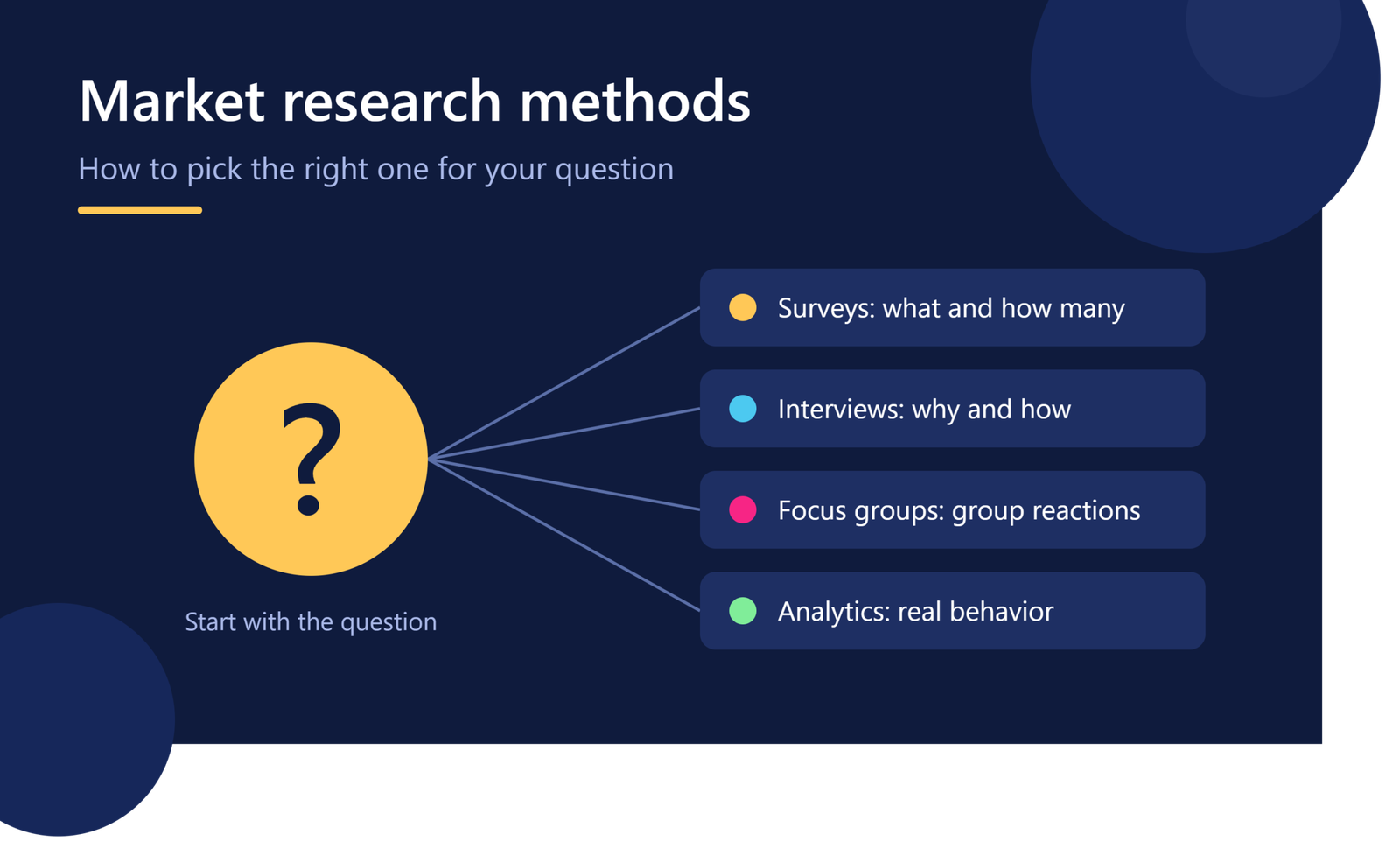
Most people start market research by choosing a tool: a survey, a focus group, a pile of competitor reports. That’s backwards. The method should follow the question, not the other way around.
This guide covers the main market research methods, what each one is good at, and a simple way to match your question to the right choice without overspending.
Start with the decision, not the method
Before anything else, finish this sentence: “After this research, I’ll decide whether to ___.”
Maybe it’s launching a product, changing a price, entering a new city or rewriting your website. If the research can’t change a decision, it’s trivia. Writing the decision down also tells you how precise the answer needs to be. A rough signal is fine for a small test. A big investment needs stronger evidence.
Primary vs secondary research
Every method falls into one of two groups.
Primary research is information you collect yourself, straight from customers or the market. It will depend on your question, but it will require time and money.
Secondary research data is data collected by someone else already: published studies and reviews, competitor websites, government data, industry reports. It’s fast and cheap, but it may not fit your exact situation.
A good habit is to start with secondary research. If the answer is already out there, you’ve saved yourself a lot of work. Then use primary research to fill the gaps.
The main methods, one by one
Surveys. A set of questions sent to many people. Useful when you’re trying to find out how prevalent an opinion or behavior is. Weak at explaining why. Keep them short, avoid leading questions and test them on a few people first.
Interviews. One-on-one conversations, usually 20 to 45 minutes. Good for understanding motives, frustrations and language. They give depth, not numbers.
Focus groups. A small group discussing a topic together. Useful for reactions to ideas, concepts or ads. A skilled moderator is a key element, as strong voices can influence the group.
Observation. Observing actual behavior, whether in a store, on a website or as someone uses a product. People will say one thing and do another and observation will reveal the difference.
Competitor analysis. Researching competitors’ products, price, messaging, reviews, and positioning. Helpful in identifying mistakes and opportunities.
Online behavior data. Website analytics, search trends, social conversations and app usage. It shows what people do at scale, though it rarely explains why.
Experiments and tests. Trying two versions of something, such as two prices or two headlines, and seeing which performs better. It’s the closest thing to proof for a specific choice.
Customer feedback and reviews. Support tickets, reviews and comments you already have. They’re often the cheapest source of real customer language.
Comparison table
| Method | Best for | Speed | Cost | Gives you |
| Survey | Measuring how many | Medium | Low to medium | Numbers |
| Interview | Understanding why | Medium | Low | Depth |
| Focus group | Testing reactions | Slow | Medium to high | Group opinions |
| Observation | Spotting real behavior | Slow | Medium | Behavior |
| Competitor analysis | Finding gaps | Fast | Low | Context |
| Online data | Seeing trends | Fast | Low | Patterns |
| Experiment | Choosing between options | Medium | Low to medium | Evidence |
| Existing feedback | Learning customer language | Fast | Very low | Themes |
The Question-to-Method Picker
Match your question to its best starting point:
- “Is there demand for this?” Start with search trends and competitor analysis, then run a few interviews.
- “Why are customers leaving?” Interviews and support tickets first.
- What fraction of the people feel this way? A survey.
- Which one will be the better choice? An experiment or test of two options (A or B).
- Who are we competing with and what are the gaps? Competitor analysis & review mining.
- What are the behaviors of the people who use our product? Observation and usage data.
- “What should we call it, or how should we describe it?” Interviews and open-ended survey answers, looking at the words customers use.
Notice that most good projects combine two methods, one that explains and one that measures. A common pairing is interviews first, to learn what to ask, then a survey to see how widespread the answers are.
A minimum-effort research plan
If you’re short on time or budget, here’s a lean version that can be done in about two weeks:
- Days 1–2: Write the decision and the three questions that matter most.
- Days 3–4: Collect secondary research: trends, competitor pages, reviews, public reports.
- Days 5–9: Run five to eight interviews with people who match your target customer.
- Days 10–12: Turn what you learned into a short survey and send it to a wider group.
- Days 13–14: Summarize the patterns, note what surprised you and make the decision.
It isn’t perfect, but it’s much better than guessing.
Mistakes that ruin good research
Asking the wrong people. Friends and family are polite. Talk to people who actually fit your target customer.
Leading questions. “Don’t you think this price is fair?” produces yes answers and nothing else. Ask neutral questions.
Trusting what people say they’ll do. Intentions are weak predictors. Behavior is stronger evidence, so look for real actions where you can.
Tiny samples treated as proof. Five interviews can reveal themes, but they can’t tell you how common something is. Don’t present small samples as precise percentages.
Looking only for confirmation. If you only hear what supports your idea, you’re not researching. Ask what would change your mind.
Collecting without acting. Research that doesn’t lead to a decision is wasted effort.
How to write up your findings
Keep the report short and useful:
- The decision you were trying to make
- What you did and who you spoke to
- The three to five main findings
- What you’re unsure about
- What you recommend, and what you’ll test next
Honest limits make the report more credible, not less.
The takeaway
The best market research methods are the ones that fit your question, your budget and the decision in front of you. Start with what already exists, add a method that explains and one that measures, and avoid shortcuts like leading questions and friendly samples. Begin with the decision, pick the method from the table, and let the evidence, not the tool, drive the result.



One Response