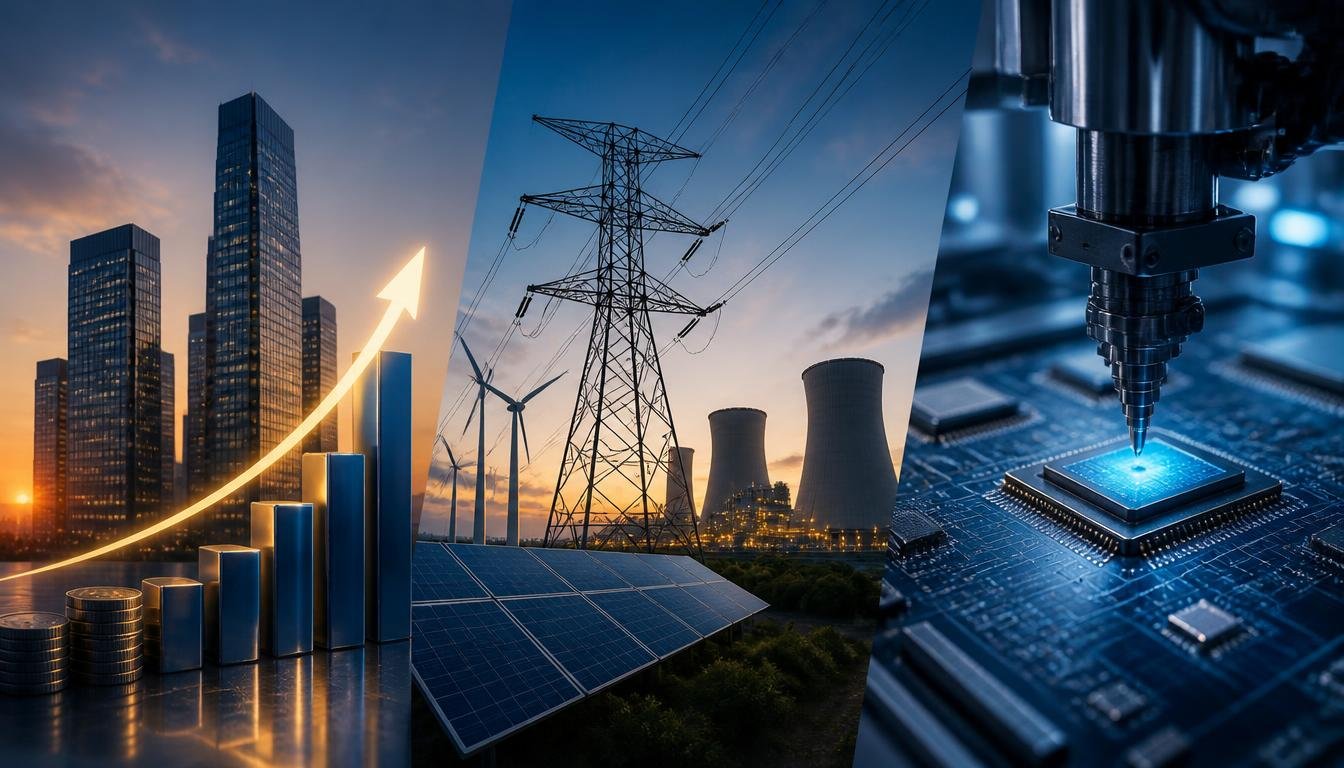
Quick answer; ai infrastructure news are currently a capital and power story rather than a chip story. Not only has Nvidia just disclosed a record quarter, but grief: hyperscalers and speculators are borrowing as much as ever, and regulators are selling “public goods,” grid resources, to these massive data centers for their cost. The best approach to each leading is to question which constraint addresses it: chips, capital or power.
Chips: Demand Continues to Ramp
It said that the company earned revenue of $96.2 billion in the second quarter of fiscal 2027, growing 106 percent year-over-year, which included data center revenue of $89.0 billion, a 117 percent increase compared to a year ago. CEO Jensen Huang stated that the demand is gaining pace and that Vera Rubin is now in full production. A caveat from Nvidia itself, in its annual filing, is that data centers, energy and capital are vitals for its customers’ buildout, and a lack of one can have a significant impact on Nvidia’s performance.
The other type of chip thread is custom silicon. According to reports, Broadcom is planning to finance over $50 billion for custom AI chips from OpenAI and its discussions are still at an early stage. These are based on secondary reports, so take them as possibly unconfirmed, until the companies announce a deal.
Capital: AI Infrastructure News on Financing
The first in a series of discussions about the financing of Ontario’s cities.
Build-out is no longer just a hardware question; it is a monetary question as well. Some recent figures:
- Nvidia and OpenAI. In August, Nvidia committed up to $105 billion to finance SB Energy’s data center in Pike County, OH that will be constructed and operated by OpenAI. This follows a series of financing activities, which have raised questions about circular financing in the AI trade, as reported in coverage.
- Third-party capital. Nvidia also teamed up with six large asset managers to build financing platforms intended to deploy $500 billion of third-party capital in data center projects.
- Debt markets. Around a $60 billion debt package was become a reality through a process of bank syndication that enabled Anthropic to acquire chips, according to a report. Lambda utilized investment-grade debt markets to finance contracted deployments of GPUs.
- New platforms. KKR founded Helix with over $10 billion committed by founding investor partners including Samsung, which contributed $1 billion to the platform, Nvidia and Vistra.
- Compute contracts. Akamai announced $11.6 billion of compute contracts with Anthropic that begin at 200 MW with further expansion options of up to 500 MW.
If forecasts of spending continue to climb. In March, BloombergNEF estimated the capex for the 14 biggest public data center operators at nearly $750 billion in 2026 versus just under $450 billion in 2025, with more than 23 gigawatts of IT capacity under construction. Meta has lowered its forecast for capital expenditure in 2026 to $130 billion to $145 billion. Investors are still skittish, and the same BNEF piece also mentions that three out of four hyperscalers saw a decline in market values following their recently released earnings due to investor worries of capital resource commitments.
Power: What Regulators Are Now Pricing
Today, the power aspect of energy, what limits its use, is what regulators are pricing.
The news is moving rapidly in Power. One weekly newsletter reports that regulators are demanding that companies pay for capacity in the grid before new capacity is installed with a FERC cost-allocation demand on PJM and a Texas audit. Information sourced from that is:
- ERCOT is conducting a survey of 461 data centers; that survey will be close the middle of October with results back by December.
- The Texas environmental agency is due to report by Oct. 19 on its compliance with a halt to the permit.
- PJM’s procurement comes into effect Feb. 28, 2027.
This source is a stock research newsletter, make sure to check the details with the stock research regulatory bodies before relying on this information. To which developers are replying with onsite generation. AB Energy claims to have guaranteed around 2 GW of power generation for five onsite data center power initiatives throughout Texas and Oklahoma. From an engineering standpoint, there is increasing rack-level power demands which will require the industry to rethink about power delivery – such as 800VDC data centres. One Wall Street analyst believes the real constriction is on the land-powers-financing side rather than in the chip-making.
The Three Constraints Lens
Three Constraints Lens (Original Framework)
Just sort this by constraint rather than reading each headline, one by one. This is an editorial framework, NOT an industry standard.
| Constraint | Headline that normally accompanies this constraint | Questions to pose |
| Chips | Quarterly results, new architectures, custom silicon | is it shipping or still in talks? |
| Capital | Package / Debt packages / asset-manager packages / financing from the vendors. | Who’s at risk? |
| Power | Production – grid rules and ‘onsite generation’ and permit halts | is the capacity actually on? |
Usually a story only has 2 or 3 rows. For instance, Nvidia’s financing in Ohio sends a capital tale that relies on power for 10 GW of proposed capacity.
Headline Triage Checklist
The Headline Triage Checklist (Linkable Asset) is linked, clickable ASSP resource.
- Is the deal inked or only rumored to be on the table?
- Who do you pay out the money to, and who do you collect the money from?
- Do you know if the power is on, contracted or just slated to be installed?
- What is the problem in the story that is addressed by the constraint?
- Does the source have a commercial interest?
- What are the numbers capex/revenue/valuation/capacity?
- Do you have a regulation date that I can look at?
- What will make a difference in the story next quarter?
What to Watch Next
Upcoming dates noted on newsletters include the Texas compliance report Oct. 19, hyperscaler third quarter results and capex guidance sometime in mid to late October, ERCOT’s survey results in December and PJM’s procurement change Feb. 28, 2027. Verify the dates with the primary source because dates may change.
Guest Post Angles
The following topics are appropriate for the technology, finance and energy publications:
- Circular financing in AI – What are the vendor financing risks and how does it work?
- Why the limit isn’t the chip and why the real limit is power: the cost of the grid and the power produced on site.
- Fine dining into the numbers of AI infrastructure companies: Capex guidance versus real capex.
Read the Next Headline With Three Questions
Read the next headline while asking and answering the following three questions.
When it comes to next ai infrastructure news, ask 3 questions: Is it a chip, capital or power story? Was the deal signed or does it just appear in the press? If an order doesn’t come in, whose money is spent? It is those three answers that will help you understand better than any one number.




One Response