Most of the lists of “best cloud HR software” rate vendors. They don’t often tell you why something that works for a 40-person startup in the US doesn’t for a 600-person company in multiple countries. This guide provides you with a repeatable selection framework, a size based comparison, and a reconciliation of the conflicting market data you will see on the internet.
What Is Cloud Based HR Software?
Cloud HR Software is an HR software that performs basic HR-related tasks like employee records, payroll, hiring, induction, performance, benefits, etc., on the vendor’s servers as opposed to yours. It provides access to HR data remotely from anywhere, with the vendor taking care of data security.
In reality, vendors are divided into three categories:
- Small business payroll software is designed for ease and automation, like Gusto.
- Mid-market suites, such as BambooHR, Paycor, Sage HR and Zoho People.
- Enterprise HCM like Workday, SAP SuccessFactors, UKG Pro and Oracle Fusion Cloud HCM.
For example, Oracle’s solution consolidates HR, payroll and workforce planning into a single data model for global processes.
How Big Is the Market? Why the Numbers Disagree
Search “cloud HR software market size” and you will find figures that cannot all be true. We compared the 2026 estimates:
| Source | Scope measured | 2026 figure |
| Fortune Business Insights | HR software | USD 26.21 billion |
| Research and Markets | HR software | $58.93 billion |
| Mordor Intelligence | HR SaaS | USD 462.26 billion |
This represents over 17x wide. The reason is scope: some analysts only consider software licenses and others add payroll processing, services and other related human resource products.
Buyers/writers takeaway: Market size is supposed to be used as a direction indicator, NOT a fact. There is a more consistent adoption signal. Mordor estimates that HR SaaS will be deployed in the cloud at 73.41% in 2025, while another tracker estimates that about 60% of HR solutions will be deployed in the cloud. The majority deployment model in all of the datasets that we reviewed is cloud; the percentage varies depending on definitions.
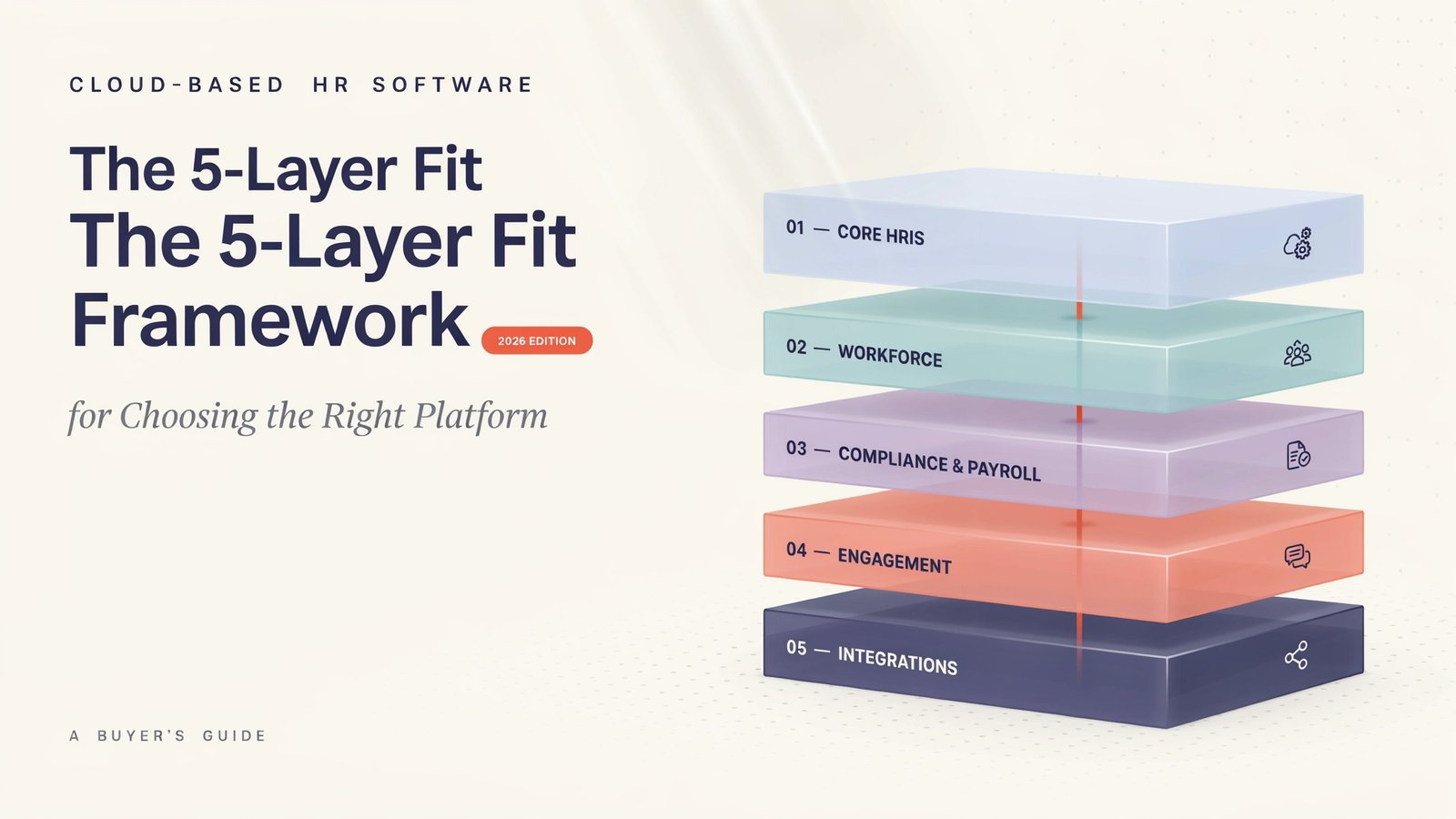
The 5-Layer Fit Framework (Original)
Vendor feature lists are nearly identical, so features are a poor basis for choosing. We evaluate fit across five layers, in order. A platform that fails an early layer should not progress, however strong its later ones.
Layer 1: Workforce shape. Are your employees salaried knowledge workers, hourly or shift-based staff, or a mix? Hourly workforces need scheduling and time tracking built in, not bolted on. One vendor comparison positions UKG as best for hourly and shift-based workforces and Factorial for shift management.
Layer 2: Geography. Count the countries where you employ people, not where you sell. Single-country SMBs can choose simpler tools. Multi-country operations need local compliance and payroll depth. SAP SuccessFactors is positioned for multi-country enterprise operations, while Personio is positioned for European HR operations.
Layer 3: Data model. Inquire about HR, payroll, time and talent sharing a single database or if they are pieced together with integrations. For instance, Dayforce claims that its HR capability shares the payroll, talent and workforce management code base, which means that data is displayed instantaneously across modules. Unified models minimize reconciliation errors. Stitched models are flexible but require integration maintenance.
Layer 4: Integration surface. Identify the five systems your HR system needs to communicate with (accounting, identity provider, chat, ATS, benefits carrier). Rippling integrates with Google Workspace, Microsoft 365, Slack and accounting software which is important if IT provisioning is a part of your onboarding process.
Layer 5: Time to value, cost. There is very limited published pricing—use what is verifiable. Deel HR has a starting price of $5 per employee per month and Rippling has paid plans starting from $8 per user per month (no free plan available). Setup times differ from prices: Personio is mentioned as being 4-5 weeks and BambooHR is mentioned as being 6-12 weeks.
Linkable asset: Rate each layer 1-5 for your organisation before doing a demo of any vendor. Any layer in the 4-5 range is a deal-breaker criterion, you don’t want to have it.
Comparison by Organisation Type
This table synthesises positioning data from several competitor reviews. A caveat on sourcing: the “best for / not ideal for” data below comes from a comparison published by HiBob, a competing vendor, so treat the ratings as directional.
Table reading: higher: not a better fit. The best case from Rippling (HR plus IT) is a liability for a team which only requires HR. First answer the Layer 1-2 questions and then match them to the “best for” column.
Common pitfalls of Cloud HR Software
The buyer-guide sources that we analyzed share a few implementation risks:
- Purchasing for demo, not workflow. Product attributes mentioned during a sales presentation are often higher-level items.
- Ignoring setup time. If you start mid-year, there will be 2 quarters of double counting the old process.
- Underestimating self-service. The savings in time come at the employee self-service level. Self-service is defined by Dayforce as allowing employees to complete forms, view payroll info and schedules, and update personal information.
- Over-buying enterprise tooling. As soon as you go enterprise, you’re adding configuration overhead that even small teams rarely recoup.
Practical rule: If you don’t have 350+ employees and one country, start with the SMB-tier tools and revisit when you reach another growth milestone. BambooHR is said to be designed for HR needs that are less complex with fewer than 350 employees.
Expert Perspectives Wanted
Practitioner contributions to this topic are published by TechVistora. We seek feedback on these points, as they are first-hand:
- HR leaders: what can you learn from moving from one platform to another?
- Multi-country payroll pitfalls for payroll specialists.
- IT and security heads: data residency and access-control audits of HR suppliers.
Contributors get a byline and the credit in the above framework.
Your Next Step
- Complete an organisation score on the five layers.
- Make a short list of three suppliers whose “best for” corresponds to your top three layers.
- Ask for a trial and try a complete process from start to finish, for example, bring in a new employee.
- Get each vendor to provide you with their timeframe in writing.
Now, the cloud HR software deployment model is the default one. The correct one to choose will be based on your workforce shape, geography and data model, not on a vendor’s position in a ranked list.




2 Responses