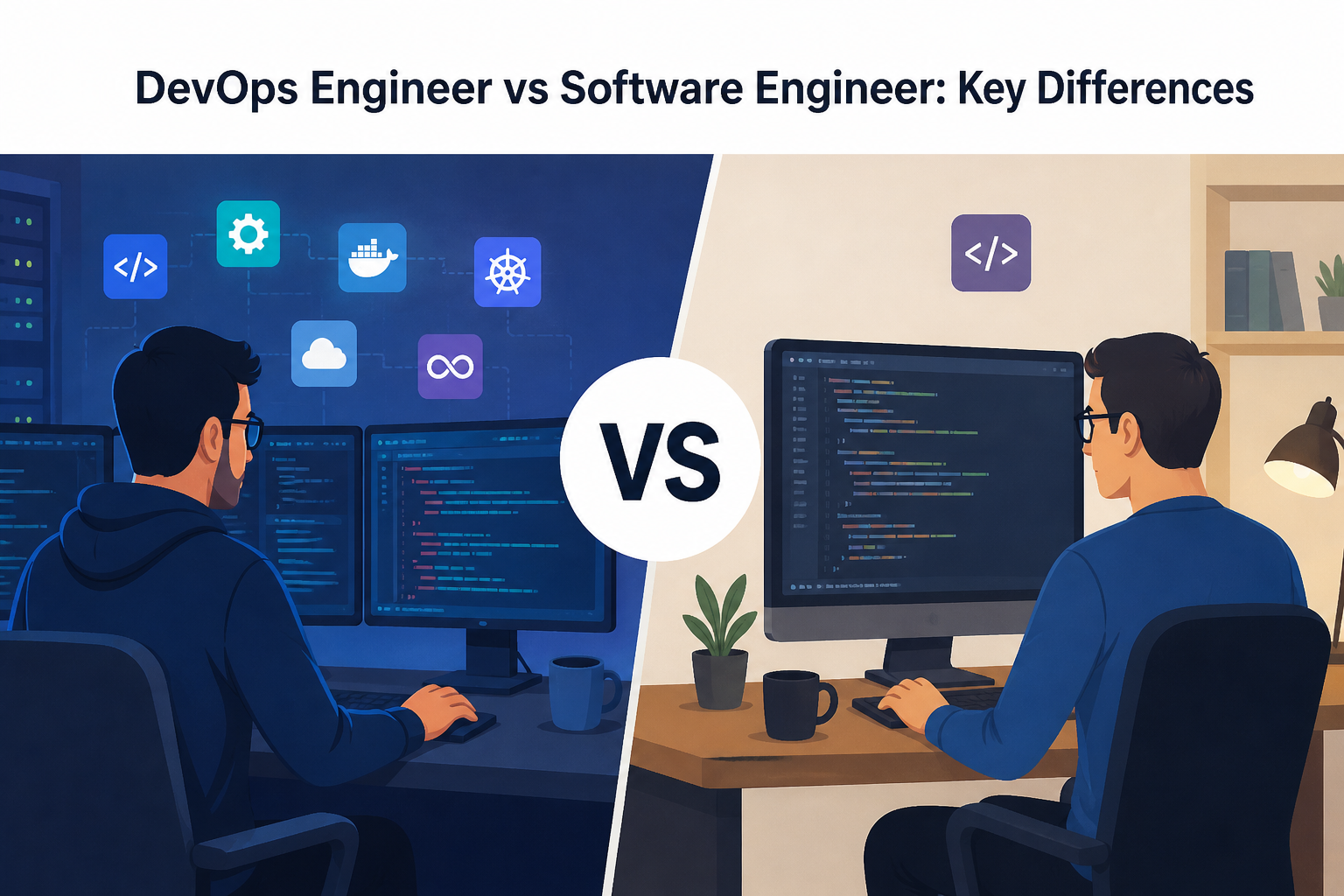
In today’s tech-driven world, it can be hard to figure out where to begin your search for a job and what job titles to consider, considering that there may seem like there is some overlap in the various areans of every role. Two of the most confusing and commonly mixed up job types are software development and engineering focused roles. A DevOps Engineer and a software engineer will both have a role to play in the creation and maintenance of technology products but with very different perspectives. Knowing the differences can assist you in determining which field is more suited to your interests and strengths.
To know the Core Roles
A Software Engineer is someone who is mainly tasked with planning and writing computer programs to develop applications, websites or systems according to defined requirements and testing them. They focus on problem-solving by programming, developing features, bug fixes, and making sure that from a user’s point of view it works the way it should.
In contrast, a DevOps Engineer will be responsible for working with DevOps processes and infrastructure to empower development and operations teams to develop, test, deploy and maintain software systems efficiently and effectively. This position is not just about coding applications, but is more about automation, deployment processes, and maintaining everything that is working in production.
Daily Responsibilities Compared
Though these two positions may work closely together in the day-to-day operations, there are many different responsibilities associated with them. A software engineer is mostly concerned with coding new features and fixing bugs in existing features, going through code reviews, and getting to know the product teams and their requirements.
A DevOps Engineer, on the other hand, is dedicated to streamlining deployment, managing cloud infrastructure, tracking system performance and creating reliable deployment processes once an application is launched. This can involve establishing continuous integration and continuous deployment (CI/CD) pipelines, storage administration, containerization, and taking part in resolving infrastructure problems, all without taking into consideration the program code.
More stuffed with details of reliably and efficiently running the application once it reaches the users after all the engineering work by the software engineers has been done.
Strengths and Weaknesses
In general, software engineers should be proficient with programming languages related to their field, such as websites, mobile apps, or back-end systems. What they know includes algorithms, data structures, and software design principles to help them create functional and scalable applications.
A DevOps Engineer will need different skills and expertise, with an emphasis on automation tools, cloud understanding and containerisation technologies, and coding for Infrastructure administration. Along with being well versed in networking and system administration concepts, a familiarity with configuration management, monitoring tools and version control systems becomes essential as well.
There is some overlap, mainly because scripting knowledge and some basics of programming are required in both the roles but the expertise demanded in these fields varies significantly between the two.
Building cooperative working relationships and team dynamics.
Software engineers typically are part of a software development team, where they have to communicate and coordinate closely with designers, product managers, and other software engineers in order to realize the features of a product. This is usually determined by how well they can turn the requirements into functional and tested code.
On the other hand, a DevOps Engineer in this kind of operation-driven career may go over both development and operations teams serving as a liaison between each to make it easy for both teams to understand one another. The role may involve interacting with the system administrator team and security team side by side at the same moment, and at the same time interacting with the development team that might have a different set of needs, work-flows, priorities, etc. – where strong communication is required.
Career Paths, Growth Opportunities
Both jobs have excellent career paths, but it can differ. Software engineers can move into more senior roles as a developer, technical lead or eventually an architect, where they can concentrate on more sophisticated application design and system architecture.
As a working example, a DevOps Engineer can evolve into new job functions such as site reliability engineer, infrastructure architect, or platform engineering lead, emphasizing the scale of the system, efficient delivery of deployment, and increasingly complex cloud operations. Some professionals also move into a management position and lead teams that work in its engineering operations.
What Route to Take?
The choice of which career path to choose from these two is going to depend primarily on personal interests and strengths. This is a traditional software engineering career, if you like features, logical problems and coding, and mostly working towards application functionality.
If you prefer working on systems thinking, automation, infrastructure management and ensuring reliability at scale, however, working as a DevOps Engineer might sound like something that you are more interested in. This track will interest people who like to work in a development but also in an operations capacity, tackling issues across the deployment deployability and system reliability rather than just developing application code.
The increasing demand for both positions
Both positions have high demand in the tech field as businesses seek not only to deploy more quickly but also to have a reliable infrastructure in place. Successful software delivery involves more than the quality of the written code – reliable and scalable systems are necessary for the code to function.
As this becomes more and more appreciated, many enterprises have been getting accustom to establishing robust teams across both departments and have been promoting environments where a DevOps Engineer and software engineers might work in parallel instead of opposition to each other.



